
Most pregnant people know to buckle up. That's not where the confusion is.
Where things get tricky is how the belt should fit, how the vehicle seat should be adjusted, and how much space you actually need between your belly and the steering wheel. Some of the advice pregnant drivers have been hearing for years is incomplete and, in a few cases, could actually make riding in the car less safe.
About the Expert
This article was written by Greg Colton, Director of the Hudson Center for Prenatal Vehicle Safety and Community Outreach Captain for UCHealth EMS in Colorado. Greg brings 13 years of EMS experience and nine years in child passenger safety, and he helped lead the development of the nationally recognized Prenatal Vehicle Safety Educator program.
His work focuses specifically on helping pregnant people understand what actually matters when it comes to vehicle safety, including where long-standing advice may be outdated, misunderstood, or missing important context.
Is It Safe to Drive While Pregnant?
Motor vehicle collisions are a leading cause of injury and death for pregnant occupants and unborn babies. Fortunately, using simple and effective safety systems, we can greatly reduce the risks faced by pregnant and fetal vehicle occupants.
When people think about the risk of driving while pregnant, they often think about direct fetal injury. What happens when the seat belt, steering wheel, or airbags contact the pregnant occupant’s belly? While direct fetal injury is a concern, it is not the main cause of fetal loss from crashes.
The main cause is a condition called placental abruption. Placental abruption is when the placenta detaches from the wall of the uterus, compromising the oxygen flow to the fetus. This can be a result of an external force on the abdomen, the pregnant occupant’s upper body moving forward, or even just the forces from how rapidly the pregnant occupant and fetus come to a stop. Because placental abruption has so many possible causes, it can happen without external force on the abdomen, without major injury to the pregnant occupant, or even in minor crashes.
Fetal loss can also be the result of maternal shock. Maternal shock occurs when the pregnant occupant loses enough blood that they can no longer supply enough oxygen to themself and the fetus. Pregnant vehicle occupants are especially susceptible to the kinds of internal injuries that can lead to shock, as their organs are pushed closer to the wall of the chest and abdomen and have less space to compress into when the upper body moves forward.
How to Reduce Risk While Driving During Pregnancy
The good news is that simple steps and common safety devices can reduce all of these risks. The three-point seat belt, a technology invented in 1959 and now required in all seats of U.S. passenger vehicles, is proven to reduce injuries and save lives for pregnant and fetal vehicle occupants. Decades of data and dozens of studies support this. You can visit www.hcpvs.org for a list of studies and links.
The most important thing a pregnant vehicle occupant can do to increase their safety is to wear their seat belt. Proper seat belt use can reduce the risk of adverse fetal outcomes by 84%.
Building on this, another important thing is to use the seat belt correctly. Improperly used seat belts can lead to injuries. Pregnant folks are often told to place the lap belt under their belly, but there is far more to proper prenatal seat belt use than just tucking the lap belt.
An often overlooked, but very important thing a pregnant occupant can do to reduce their risk is to properly adjust their vehicle seat. The vehicle seat adjustments have significant effects on the fit of the seat belt and the ability to control the vehicle.
Unfortunately, only ten percent of pregnant vehicle occupants wear their seat belt and adjust their seat correctly.
What Is the Safest Driving Position While Pregnant?
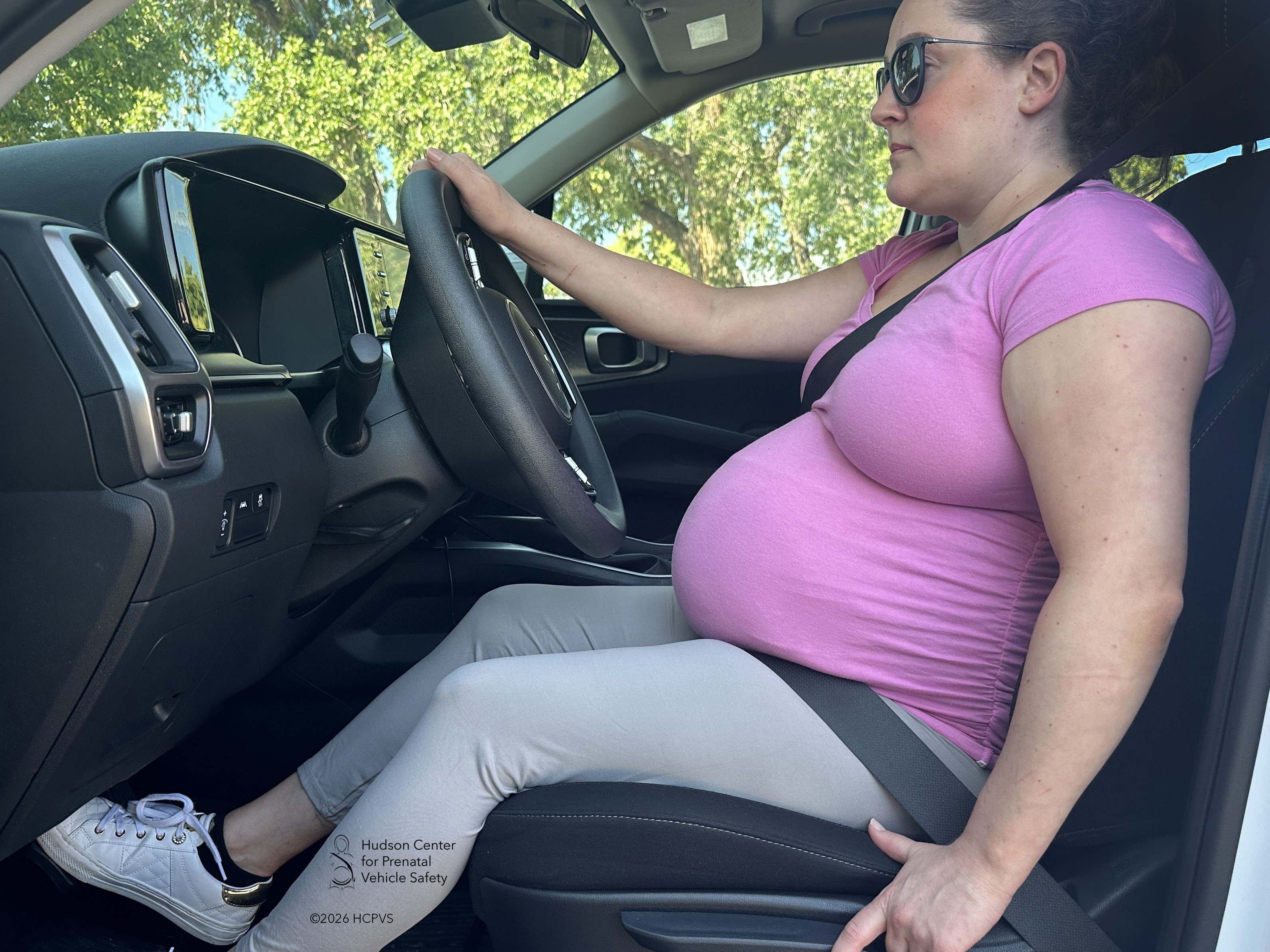
Based on the current information we advise pregnant drivers to adjust their seat and steering wheel so they can press the brake pedal to the floor and grasp the top of the steering wheel with their arm slightly bent. This means that some pregnant drivers may have a small distance between their belly and the steering wheel. But the best way to keep your belly from contacting the steering wheel is to not be in a crash. We do not want to sacrifice the ability to brake and steer just to get an extra inch of space.
How Should You Wear a Seat Belt While Pregnant?
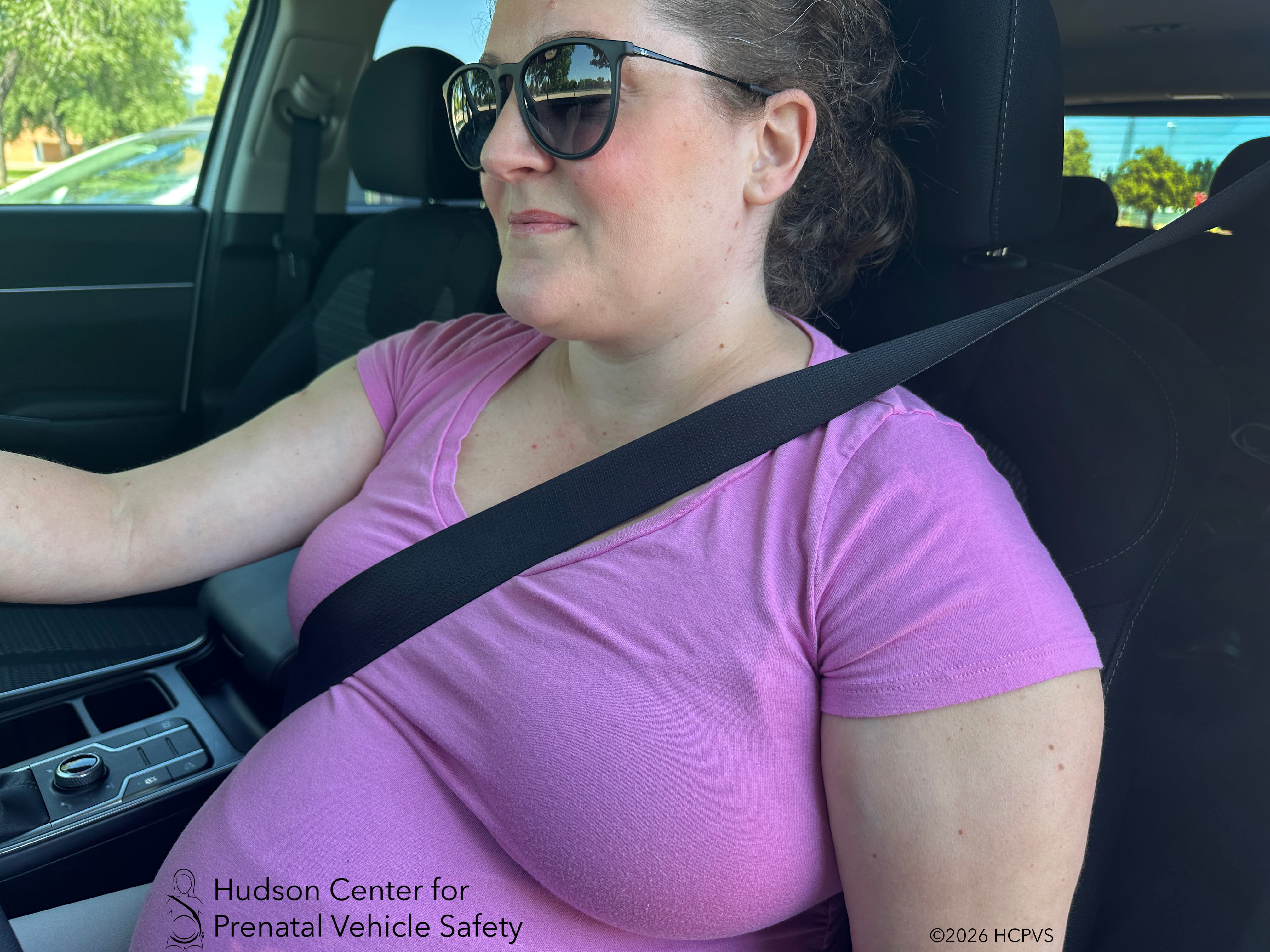

- Lap belt under the curve of the belly and resting flat on the hips.
- Shoulder belt to the side of the belly, diagonally across the center of the chest, and resting on the center of the collarbone.
- Vehicle seat in a comfortable upright position and adjusted so the occupant can press the brake pedal to the floor.
- Steering wheel adjusted so the airbag is directed towards the chest and the pregnant driver can grasp the top of the wheel with their arm slightly bent.
How Far Should Your Pregnant Belly Be From the Steering Wheel?
One of the most common questions we get asked is how much space there should be between a pregnant driver’s belly and the steering wheel. This is an area where there is some misinterpreted guidance.
There is a standard recommendation in the vehicle safety industry that there needs to be at least ten inches of space between a driver and the steering wheel. The reason for this space is the airbag built into the steering wheel. The airbag needs ten inches of space so it can fully inflate before the driver contacts the airbag. These ten inches are measured from the center of the airbag to the driver’s chest.
This guidance is sometimes misinterpreted for pregnant drivers, leading people to think there needs to be ten inches of space from the bottom rim of the steering wheel to the driver’s belly. We could not find many studies on the pregnant belly to steering wheel distance so we began measuring the distance from the bottom rim of the steering wheel to the nearest point on the driver’s belly in a straight line parallel to the floor.
Out of 1,610 measurements taken only four pregnant drivers had ten inches of space or more between the bottom rim of the steering wheel and their belly. This means that ten inches of space is not practical or possible for 99.8% of pregnant drivers measured. Ten inches of space is also likely not necessary. If this much space was necessary to prevent a driver’s belly from contacting the wheel and almost all pregnant drivers had less than ten inches of space, then injuries from bellies contacting steering wheels would be much more prevalent.
This is an area that deserves more testing and research. How far forward do pregnant drivers travel in a crash? How often do pregnant drivers contact the steering wheel with their belly in a crash? If this happens, what injuries do we see from it?
Are Airbags Safe During Pregnancy?
When it comes to airbags and prenatal vehicle safety, there are a few misconceptions and some inaccurate recommendations. Airbags are sometimes portrayed in a negative light with statements like they deploy at 200 miles an hour or they are powered by an explosive. Yes, they deploy quickly. True, there is a small explosive. But language like this implies that airbags are more dangerous than they really are.
The truth is that decades of data show us that airbags reduce injuries and save lives for pregnant and fetal vehicle occupants. Airbags can cause injuries; however, most airbag injuries are minor, and many of the occupants injured by airbags were not wearing their seat belts, which increases their chances of airbag injury.
There are two inaccurate recommendations involving airbags. The first is that a pregnant driver should tilt their steering wheel up to direct the airbag away from their belly. Again, the evidence shows us that airbags are not dangerous for unborn babies. However, there is evidence that the rate of neck injuries increases when the airbag is directed too high. Tilting the airbag too high may increase neck injury risk, so changing the steering wheel position to avoid an unproven fetal risk can introduce a different, known risk.
The other inaccurate recommendation is that a pregnant passenger should move their seat back as far as possible to get away from the airbag. This actually makes a pregnant passenger less safe. It puts a gap between the passenger’s shoulder and the shoulder belt. In a crash, their upper body will move further forward before stopping. That movement increases the chances of placental abruption, maternal shock, and direct fetal injury. Modern passenger airbags deploy upwards and fold outwards. A pregnant passenger sitting in the correct position for their shoulder belt should not contact the airbag before it is fully inflated.
Airbags are another area that deserves more research. Airbag technology is constantly improving, and we need to see how the most current airbags affect pregnant occupants. Most of the research focuses on frontal airbags. There are also other airbag systems, such as inflatable seat belts, that merit more investigation.
Are Pregnancy Seat Belt Adjusters Safe?
Pregnancy seat belt positioners, often called seat belt adjusters, are devices that reroute the lap belt so it is no longer resting against the user’s belly. If you have a seat belt positioner or are thinking of getting one, we would like to thank you for thinking of your baby’s safety before they are born. Unfortunately, pregnancy seat belt adjusters are unsafe and not recommended.
There is a good chance that the positioner will not work in a crash. Many pregnancy seat belt positioners claim to be crash tested. An independent group tested four types of positioners. Some broke apart. Some came up off the seat and hit the dummy. All of them caused the dummy to move further before stopping. There is also video going around social media of a pregnant woman breaking a pregnancy seat belt positioner in half bare-handed.
Pregnancy seat belt positioners do not solve the real problem. Most of the forces acting on the uterus in a crash are internal forces from the pregnant occupant’s body and the sudden stop of the crash. Simply removing the lap belt pressure on the belly does not help those internal forces. And the pregnant occupant moving further before stopping can actually increase the internal forces.
The devices are also not approved by the vehicle manufacturer. The vehicle manufacturer designed their seat belt to work in a particular way and apply a certain amount of force to the thighs. Rerouting it changes the seat belt from how it is designed and tested.
The biggest reason not to get a pregnancy seat belt positioner is that you do not need one. There is abundant evidence that the properly worn seat belt will reduce injuries on its own. And records from prenatal seat belt checks indicate that many pregnant participants who had issues with the comfort or fit of their lap belt simply did not know how they could make the lap belt more comfortable.
Want more on these products? See our full post on pregnancy seat belt adjusters.
What Should You Do After a Car Accident While Pregnant?
Any pregnant occupant involved in a crash should go to a hospital for evaluation. Negative fetal outcomes can result from minor crashes without injury to the pregnant occupant. They should also notify their OB care provider so their provider can do additional monitoring after the pregnant patient leaves the hospital. When it comes time to deliver, the pregnant patient should notify the delivery staff that they were in a crash earlier in their pregnancy in case there are effects that come up during delivery. Once they deliver, the pregnant patient should let the people helping with feeding and lactation know in case the seat belt affected their breasts.
Does Pregnancy Driving Advice Change as Your Belly Gets Bigger?
Fortunately, the prenatal vehicle safety recommendations do not change as pregnancy progresses. It is still important to wear the seat belt, wear it correctly, and properly adjust the vehicle seat whether someone is four weeks, forty weeks, carrying large, carrying small, pregnant with one baby, pregnant with three babies, 20 years old or 50 years old.
Wondering how late in pregnancy you can drive? We cover that in When to Stop Driving When Pregnant. And if a road trip is coming up, our guide to long car rides while pregnant has break timing and comfort tips for each trimester.
Getting ready for the drive home from the hospital? You've got time to get the car seat handled before baby comes. Our free Car Seat Finder Quiz asks about your car and your family, then gives you a list of seats that fit.
A special thank you to Greg Colton (@hcpvs) for sharing his expertise with us and helping make sure we’re bringing you the most current information and guidance. HCPVS Website