
When you bring home a newborn for the first time, they come with lots of safety instructions. Unfortunately, you probably won’t receive an actual manual that tells you the dos and don’ts of caring for an infant. However, between family advice, required hospital videos, personal research, and common sense, you can find the info you need to keep your baby safe. And, let’s be honest, a lot of newborn safety centers on keeping your infant’s head in a safe position!
As a result, many parents are concerned about their newborn’s head moving around in the car seat. But, is this a cause for concern? If so, what do you do about it? These are the questions we’re aiming to answer for you today. Here’s what you need to know about newborn head support in their car seat:
What Do I Need to Know About Newborn Head Support in Car Seat?
Newborns are delicate! But, you probably already know that. Most parents have a general fear of how fragile their newborn babies really are, and many regulated and unregulated baby gear has come out to respond to parent’s fear. So, it’s hard to know what you should use and what could actually be putting your child at greater risk for injury.
Are Car Seat Head Supports Safe?
If it came in the box with your car seat, it is safe. If you bought it separately, then the car seat head support is not safe. It has not been crash tested with your car seat, and it could alter the seat's efficacy in a crash.
Do Newborns Need Head Support In Car Seat?
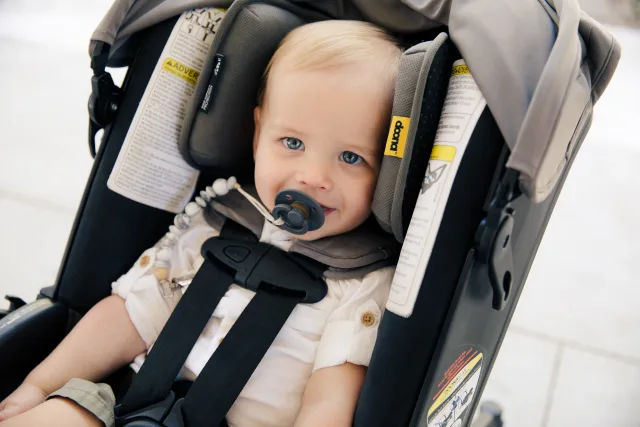
In most cases, no! Having head supports in a car seat for a newborn is not necessary and often we don’t recommend it. The only exception? If the car seat manual says the head support is required until your baby hits a specific height or weight. Otherwise, the “optional” newborn head supports have a tendency to push your baby’s head and neck forward, which can put your infant at risk of positional asphyxia. Despite your fears, it’s not necessary to prevent your child’s head from the gentle jostling that comes with any car ride. And we never recommend adding aftermarket head inserts that did not come in the box with your car seat!
How To Support Newborn Head In Car Seat
Check the manual to see if the head support is required.
First of all, check the manual to see if it gives any information on when and how to use the newborn head support (if it comes with one.) If the head support is labeled as required for a certain weight or height, use it as instructed until your baby meets the max requirements.
Consider removing the head support from the start.
If there is a newborn head support that comes with the car seat, but it is not mentioned in the manual or it is labeled as optional, we recommend removing it. The head support can tilt your baby’s head forward and put them at risk of positional asphyxia without providing really any other benefit. Remember, it’s okay if your infant’s head moves in their car seat.
Allow your child to rest in the natural turned position.
Many infant head supports have the goal of fixing your child’s head forward and preventing it from moving. As we’ve already explained, preventing movement isn’t necessary for safety. Beyond that, maintaining your baby’s head in a forward, fixed position is also unnecessary.
Think about it, when your infant sleeps, he or she likely turns their head slightly to the side because they have a slightly enlarged back of the head. This is a natural position for sleeping and lounging! It’s best to allow your child’s head to naturally turn that way.

Don’t use any aftermarket products to prop the head.
As tempting as it may be, never use any aftermarket products to position and prop your infant’s head. It’s unnecessary and can actually prove to be unsafe! Aftermarket products for car seats (unless made by the manufacturer of your car seat), are not crash-tested, safety-tested, or regulated.
(If you have a premature baby or a medically complex infant, you may need a special car seat. You can take a look at our recommended car seats for special needs children and our recommended car seats for preemies.)
Double-check that your car seat is safely reclined.
Some infant car seats have multiple recline options suitable for different stages of your child’s growth. Before you put your infant in their car seat, double-check the manual and the indicators on the car seat to ensure that the recline is correct. This will help keep your baby’s head in a safe position and reduce the risk of positional asphyxia.
The newborn head support is only necessary if specified by the car seat manual.
At the end of the day, you don’t need any additional head support for your newborn other than what the car seat manual specifies. Never add aftermarket products or additional padding that didn’t come in the car seat box.
When to Remove Head Support From the Car Seat
The head and body supports that come with a seat, if any, often have weight limits. Check your manual for details.
How Should a Newborn Fit in a Car Seat?
Harness below the shoulders
The harness should be coming from at or below the shoulders. If it's coming from above, see if you can lower the harness anymore. If not, you will need a new seat.
Crotch buckle close to the baby's bottom
Most infant seats have a few crotch buckle positions. Make sure you are using the slot that is closest to the baby's body. Some seats may also have away to shorten the crotch buckle strap. Check your manual for details.
Harness should pass the pinch test
Make sure to tighten the straps around the hip. To check for harness tightness, make sure you can't pinch the harness at the baby's shoulders. Check out this video for a demo.
How Long Can a Newborn Be In a Car Seat?
No one should be in the car for more than two hours, including a newborn and you. When you are done using the car, take the baby out of the car seat. It is not a safe sleep space outside of the vehicle.
This is the best way to keep your baby safe in their seat! For more information on newborn car seat safety, head to the Safe in the Seat blog for posts like these:
- How to Swaddle a Baby in a Car Seat
- Can You Put a Car Seat on a Shopping Cart?
- When to Take the Newborn Insert Out of the Car Seat
- Can You Feed Your Baby in Their Car Seat?
- How to Choose a Car Seat for a Newborn
As an Amazon Associate, Safe in the Seat earns from qualifying purchases.