
Baby's First Car Ride Home: A CPST's Checklist for Day One
When I was pregnant with my first, I knew I needed a car seat. That was about it.
My mom did the research with a clipboard. We put the base in the middle seat and used the lower anchors wrong. At discharge, the staff wouldn't help me buckle my son. A week later, our newborn photographer gently told me his harness was way too loose.
I wasn't the only one. A study in The Journal of Pediatrics found that 95% of families made at least one car seat mistake taking their newborn home. The same study found that families who worked with a car seat tech before baby arrived were far less likely to make those mistakes.
So let's do the work now, while you have time. Let's make this simple.
Your baby's first ride home at a glance
- Choose a rear-facing seat that fits your baby, your car, and your life.
- Install it a few weeks before your due date.
- Have a certified car seat tech (CPST) check your install.
- Practice buckling with a doll, you and your birth partner.
- Bring the infant seat into the room and buckle baby there.
- Dress baby in thin layers and check the harness before you leave.
- Drive distraction-free and take baby out of the seat when you get home.
Choose a rear-facing car seat
Every newborn rides rear-facing. Infant seats and convertible seats both work rear-facing from birth, so either one is a safe choice.
I think about choosing a car seat like choosing shoes. You don't wear hiking boots to a wedding, and you'd never buy the top-rated pair in the wrong size. The right seat fits your baby, your car, and your life first. Crash features, convenience features, and price come after that. Fit first, then features.
For the first ride home, a lot of families love an infant seat. It's made for tiny babies, it clicks in and out of a base, and you can carry it right into the birth room. More on why that matters below.
Not sure where to start? Take my Car Seat Finder Quiz or read how to choose a car seat for your newborn.
Where should a newborn car seat go in the car?
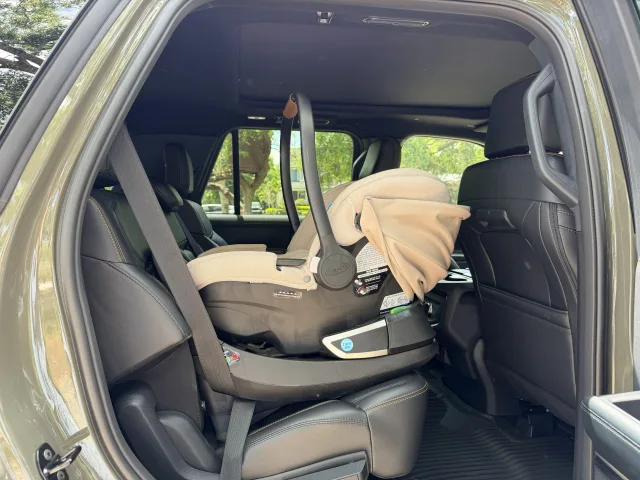
Any back seat can work, as long as you can get the right recline and a tight install. The middle can be a great spot when your car allows it.
Check your vehicle manual first. Many cars don't allow lower anchors in the middle seat. That's the exact mistake my mom and I made with my first. A seat belt install in the middle is often the fix. Here's more on the safest spot for a car seat.
Install your seat a few weeks before your due date
Give yourself time. Babies don't always wait for their due date, and you want room to get your install checked.
Read your car seat manual and your vehicle manual together. Then go through my safe install checklist. Once it's in, register your seat with the manufacturer so you'll hear about any recalls.
Watch first-time parents Jamie and Mike install their infant seat and practice buckling with me, weeks before their baby arrived.
Have a car seat tech check it
Manuals can't cover your exact car, your exact seat, and your baby all at once. A child passenger safety technician (CPST) can.
A CPST checks your install and teaches you how to buckle baby. This is the step the research says makes the biggest difference.
My team and I do 1:1 consults virtually, so you can do this from your driveway, wherever you live.
Clear out anything that could fly
Anything loose in your car can fly forward in a crash, even on a short drive home. Put water bottles, umbrellas, ice scrapers, and anything heavy in the trunk or secure them. Here are my tips to keep your car organized.
Practice buckling before baby arrives
Grab a doll or a stuffed animal and practice. Loosen the harness, buckle, tighten, move the chest clip. Do it a few times.
Your birth partner should practice too. They can do the first real buckle while you rest. Once baby's here, practice the real thing in your room before discharge.
These videos help: How to Buckle Your Newborn in a Car Seat and Proper Position of an Infant Car Seat Harness.
What should baby wear for the ride home?
Thin layers, like a onesie and a footed sleeper. No snowsuits, puffy coats, or thick buntings under the harness. They leave hidden slack in the straps.
Cold outside? Buckle baby first and tighten the harness. Then you can tuck a blanket around them with their arms out. You can check out some other options here.
Warm outside? Dress baby in one light layer and skip anything that drapes over the seat, since covers can trap heat around baby. Here’s why I don’t love car seat covers.
Will my baby need a car seat test?
Your place of birth may do a car seat test before discharge if baby was born before 37 weeks, weighs under 5 lb 8 oz (2,500 g), or has a condition that affects breathing. The American Academy of Pediatrics recommends it for babies born before 37 weeks.
Most full-term babies won't need one. Learn more about the newborn car seat test.
Bring the infant seat into the room
If you have an infant seat, bring it to your room before discharge. Buckle baby in the room, not at the car. You'll have good light, room to move, and no weather. Nobody's waiting behind you.
Have your birth partner carry the seat. You're healing, and your doctor may limit what you lift.
Using a convertible seat? Buckle at the car, with the car pulled up to the door so you're out of the heat, cold, or rain.
Have the car close and comfortable
Newborns can't regulate their temperature well yet. Before you leave, have someone pull the car up to the door and warm it or cool it to a comfortable temperature. You won't walk far right after birth, and baby goes straight into a comfortable car.
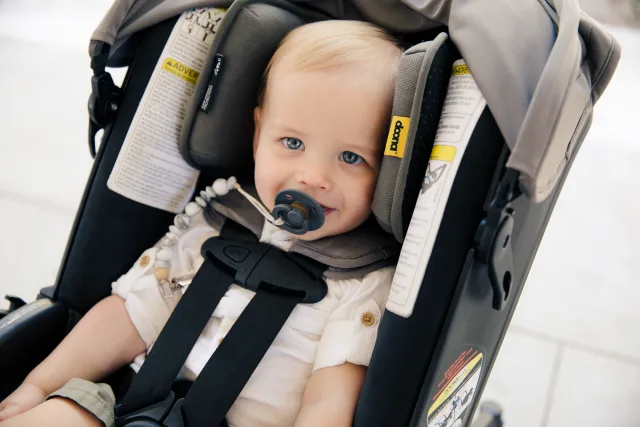
Double-check the harness
Before anyone closes that door, check these 5 things:
- Straps come from at or below baby's shoulders.
- Harness is snug: you can't pinch any slack at the collarbone.
- Chest clip sits at armpit level.
- Crotch buckle is in the slot your manual shows for a newborn.
- Recline indicator is in the newborn range.
And nothing's twisted.
This is the step I missed with my son. His harness looked fine to me. It wasn't. Nurses are amazing, but most aren't trained car seat techs, so their okay isn't a car seat check. You and your birth partner are the check.
Drive distraction-free
Whoever drives home has one job. Phone away, music set before you leave, speed limit all the way. If you can, have an adult ride in the back next to baby, so someone can see that baby is safe and breathing. Here's my list of distractions while driving.
How long can a newborn be in a car seat?
Only as long as the drive takes. Car seats are for travel, not for sleep.
Check your manual, though most don’t set a time limit. Some, like Evenflo’s, say to keep time in the seat as short as possible, and the AAP suggests a break every 2 to 3 hours on longer drives. Long drive home? Plan stops, and have an adult in the back who can see baby’s face.
Take baby out as soon as you get home
Baby fell asleep on the drive? Totally normal. Once you're home, move them to a flat, firm sleep surface on their back, even if they're snoozing. Here's more on sleeping in a car seat.
You're ready for day one
You don't have to know everything about car seats today. You need a seat that fits, an install that's been checked, and a plan for buckling baby in the room. Control the controllable.
You've got this, and I've got you.
Want more help getting ready for baby? Join my newsletter for simple, real-life car seat tips for expecting families, straight to your inbox.
About the Author: Michelle Pratt is a certified Child Passenger Safety Technician (CPST) since 2018 and the founder of Safe in the Seat. She's a mom of two who started out like a lot of you, standing in front of a wall of car seats with no idea where to begin.
As an Amazon Associate, Safe in the Seat earns from qualifying purchases.