You set him in the seat, and he looks so small. You tighten the straps. Then you check them again. And again.
If you’ve stood over a car seat like this, you’re in good company. Every new parent wonders how a newborn should fit in an infant car seat. If you have the UPPAbaby Mesa V3, there’s one more question: does the infant insert stay, or does it go?
I’m Michelle, a CPST since 2018. By the end of this post, you’ll know what proper newborn fit looks like and whether your baby needs the insert in the UPPAbaby Mesa V3. The idea is simple: check the steps, not the scale.
A newborn fits the Mesa V3 when the harness is snug at or just below their shoulders and their chin stays off their chest. Whether your baby needs the infant insert comes down to that fit, so check it without the insert first.
How Should a Newborn Fit in an Infant Car Seat?
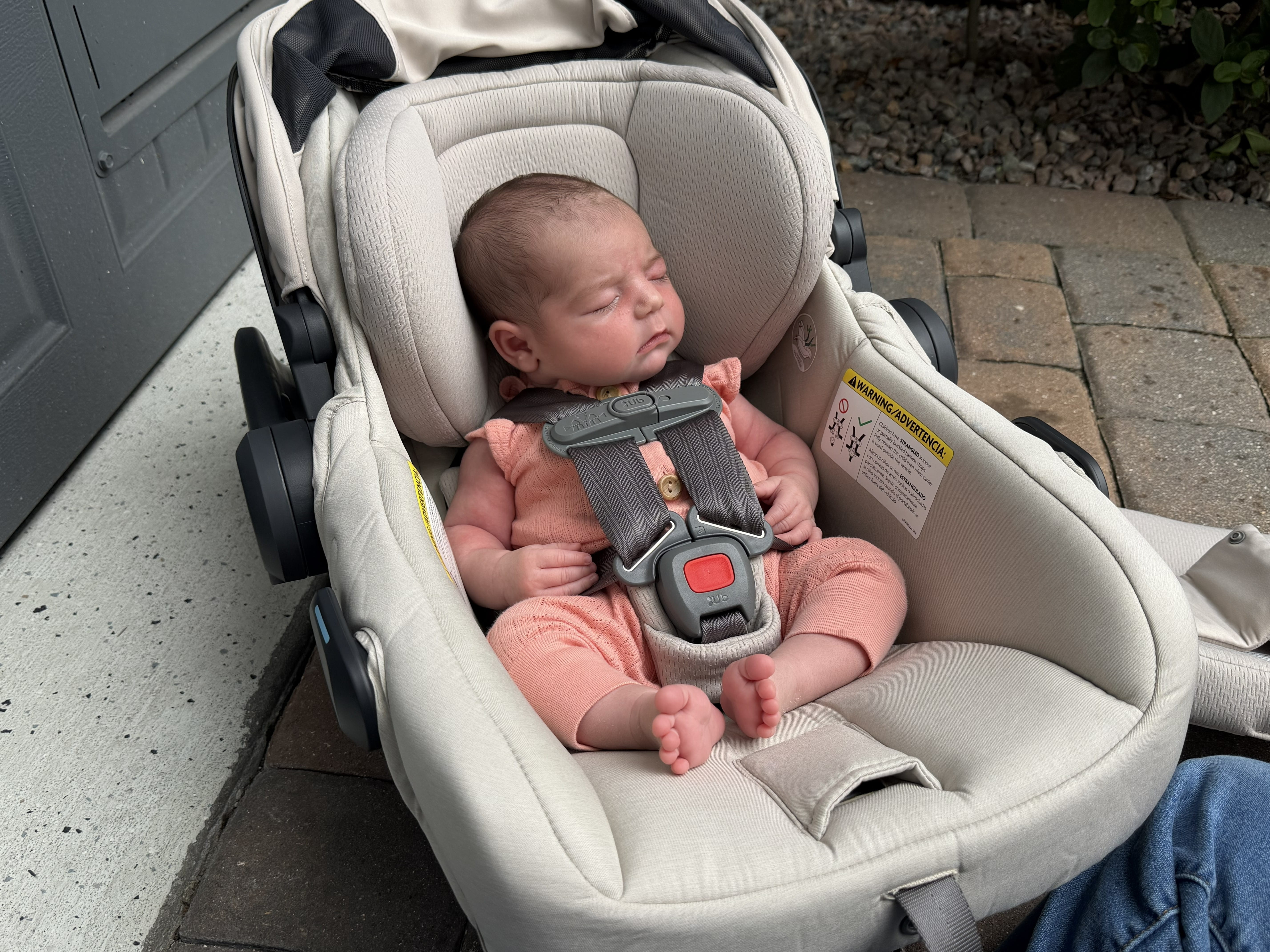
A newborn should sit with their bottom and back flat against the seat. The harness should be at or just below the shoulders. The straps should be snug, and the chest clip at armpit level. Their chin should stay off their chest, and the seat should be installed at the correct recline angle.
Here’s how to check each of those things and why they matter:
- Bottom and back flat against the seat. A baby who sits all the way back is supported throughout their body, so they don’t slide down and slump.
- Harness at or below the shoulders. In a rear-facing seat, straps at or below the shoulders hold your baby snug against the seat back and reduce how far they shift upward in a crash.
- Harness snug enough to pass the pinch test. Loose straps let your baby slide down and slump. Snug straps hold them in place, which keeps their airway open and protects them best in a crash.
- Chest clip at armpit level. This keeps the straps resting over the shoulders.
- Chin off the chest. The head should be in line with the body and not falling forward.
- Seat at the correct recline. The recline indicator shows the seat is angled as the manufacturer intended.
These checks apply to any infant car seat. The two that trip parents up most are harness tightness and head slump, so we’ll start there, then move on to the Mesa V3.
The Pinch Test, Step by Step
The pinch test tells you whether the harness is snug enough. Buckle your baby in, pull any slack up from around their hips, then tighten the straps. Now try to pinch the harness at your baby’s collarbone. If you can pinch a fold of strap, tighten a little more.
If you still aren’t sure, you can try the reverse pinch test. Start with the harness loose. Pinch the strap at your baby’s collarbone with two fingers and pull the harness adjuster strap with your other hand. When the strap slips out of your fingers, it’s tight enough.
What Does Head Slump Look Like in a Car Seat?
Head slump looks like a chin dropping straight down toward the chest.
A head turned to the side is normal and fine. Little heads are supposed to move.
If you see this on your baby, first, check the recline on the base or the seat itself to make sure it’s correct. Then, check that the harness is tight enough and coming from at or below the baby’s shoulders. If your seat has an insert, ensure you are using it as specified in the car seat manual.
A baby slumped in a car seat is a fit problem, and fit problems have fixes! If the fix doesn’t come easily, a CPST can look at it with you.
Why Infant Car Seats Come With Inserts
Infant car seat inserts fill extra space so a small baby sits correctly in the harness, and they are crash-tested with that specific seat. That’s why the insert in the box is the only one you can use.
Don’t add any aftermarket inserts because they weren't tested with your seat. For more on this, see Newborn Head Support in a Car Seat.
Is the UPPAbaby Mesa V3 Infant Insert Optional?
The UPPAbaby Mesa V3 comes with an insert. Yes, its use is optional. Your baby’s fit determines whether you use it.
The manual says “the infant insert is recommended between 4 and 11 lbs,” and “You may continue to use beyond 11 lbs until all criteria are being met.”
This means it is not required if you don't need it, and you can use it beyond 11 lbs if your baby needs it for a proper harness fit. This is where checking the steps, not the scale, becomes important.
How to Decide Whether Your Baby Needs the Mesa V3 Insert
The Mesa V3 infant insert is a tool. It’s a fit feature that is there if you need it to achieve proper fit. Most often I see that a baby fits just fine with the infant insert removed. I recommend you do your first “fit check” with the infant insert removed. Remove the insert first, then run through the checklist below with your baby buckled in the car seat and installed in the car. If everything checks out, keep the insert out; you don’t need it to achieve proper fit.
If your baby does not pass all 5 steps below with the insert removed, then put the insert back in and run through the checklist below again.
Here’s what to look for:
- Harness should be coming from at or just below the baby’s shoulders. The harness moves up and down with the headrest, which has 25 positions to find the proper fit. The manual states that the harness should be at or 1-2 positions below the child’s shoulders.
- Crotch buckle snug against your baby with no gap. Your baby shouldn’t be sitting on top of it. There are two crotch buckle positions, so check which one suits your baby. The bottom of the buckle tongues should be no more than 0.5 inch above your baby’s thighs.
- Harness tightened properly. Make sure to remove any slack from the hip area when tightening the harness. When tightened properly, you should not be able to pinch the straps near the baby’s shoulders.
- Chest clip at armpit level. After tightening the harness, slide it up or down until it lines up with the baby’s armpits.
- Baby should not be slouching. The head should be in line with the body, either facing forward or turned to the side.
In this video, I was fitting 2-week-old Teddy (9 lbs) and going through the checklist. She passed the 5 steps of the fit check without the insert in use. If she had failed any of those steps, I would have put the insert back in and run through the checklist again.
What to Do If the Fit Isn’t Right
If you’ve tried to position your baby to pass all 5 steps on the checklist and you still cannot achieve the proper fit, contact UPPAbaby customer care or book a virtual fit appointment.
Remember, as your baby grows, their fit in the car seat will change, and you will need to make adjustments.
Every Baby Is Built Differently
Length, torso, head size, and gestational age all affect how a baby fits in a car seat, so fit depends on your child and your seat. Some babies fit well without the insert from day one, while others need it for a little while.
If your baby arrives early, ask whether your hospital runs a car seat tolerance test on preemies before discharge.
Check the Steps, Not the Scale
I get it. It’s a bit confusing that UPPAbaby gives you a weight range on the insert itself. But it’s a guideline, not a rule. Your baby’s fit tells you whether they need the insert. The number on the scale doesn’t.
Rewatch the video and screenshot the checklist, so you’re ready when your baby arrives.
If you need another set of eyes on your seat, get 1:1 help from one of UPPAbaby’s CPSTs.
UPPAbaby Mesa V3 Newborn Fit FAQs
Do you have to use the infant insert in the UPPAbaby Mesa V3?
No. If your baby fits well without it, you don’t need it. If they need it for a good harness fit, use it.
When should I take the infant insert out of the Mesa V3?
Remove it whenever your baby fits properly without the insert, whether they are 1 day old or 2 weeks old. Don’t rely only on the 4-11 lbs guideline. The decision to use it should be based entirely on how the baby fits in the seat.
Can my baby use the Mesa V3 insert after 11 lbs?
Yes, if they need it to fit well in the harness. The manual states that it can be used beyond 11 lbs if needed. Use the fit check as a guide and ask a CPST if you are still unsure.
How do I know if my newborn’s head is slumping in the car seat?
Look for their chin to be dropping straight down toward their chest. This is why it’s important to do a harness fit test and install the seat at the proper recline before the first ride. If you see chin-to-chest, you need to make adjustments.
Can I use a rolled towel or head support in my baby’s car seat?
No. Only use the insert that came with your seat. Don’t add anything else, including extra padding or rolled towels by your baby’s head. The one exception: UPPAbaby allows a rolled towel under the base if you need it to reach the right recline.
Where should the Mesa V3 headrest be for a newborn?
Moving the headrest up is what moves the harness up, so set the headrest by where the harness sits. The harness should be coming from at or 1-2 positions below the baby’s shoulders.
Who can check my baby’s car seat fit?
A CPST can check your baby’s car seat fit. You can book a free virtual consultation with UPPAbaby or a Talk to a Tech with my team at Safe in the Seat.
This post is sponsored by UPPAbaby. As always, the fit guidance is from Michelle Moschel Pratt, an Internationally Certified Child Passenger Safety Technician.